
An Analysis of Story, Structure, and Realism in Pro Wrestling
Key Takeaways:
- A great wrestling match uses realism, structure, and innovation to tell a satisfying story.
- Selling, pacing, and crowd management are more important than flashy moves.
- Workrate appeals to hardcore fans, but storytelling connects universally.
- Innovation and character-driven moments make matches memorable.
- The best matches resonate emotionally instead of just technically.
Pro Wrestling is often judged by star ratings or viewership metrics, but what actually makes a wrestling match good? In this article I analyse the core elements of match quality: realism, structure, workrate, innovation, and storytelling. The conclusions I make here are what I use to guide my thinking when I am rebooking wrestling storylines. Story and emotion always come first.
For years I’ve read forums and watched commentary videos about the best and worst that pro wrestling offers. While, initially I found it interesting, it soon became background noise as all the opinions blended into one dull voice. The core of my problem was that the level of analysis in these discussions was always so shallow. I always heard about the matches of the year and certain moments that had people jumping out of their couches. But no one really explained why or how wrestling accomplished this. Just that it did. Maybe they pointed out a few key moments like a flashy reversal sequence or a callback to a past iconic moment, but is that really all that makes a wrestling match good? Why are moments like these even good in the first place?
After many years sitting on this frustration, I’ve ended up coming to my own conclusion. And that’s helped me make this site with the philosophy of providing analysis of wrestling that is deep and thoughtful and not just the surface level “goods”, “greats”, and “five stars”.
Why “Looking Real” Matters in Pro Wrestling
What makes a wrestling match look real?
The first most obvious aspect that makes good wrestling good is that it looks real. Most pro wrestling matches don’t actually look like two people having a real fight. Real fights between normal people are sloppy and messy and sometimes even quite boring. If pro wrestling were to mimick this, people wouldn’t watch it because if they’re going to watch something messy and boring, they might as well watch the real thing. So, pro wrestling needs to look real in the context of a dramatised form of fighting with the goal of entertaining. The strikes need to look like they connect and the slams need to look like the wrestlers are trying to put each other through the mat. Everyone knows wrestling isn’t real, but when you see a punch that clearly doesn’t connect it just shoves that fact in back in your face and makes you feel silly for watching it. It’s the equivalent of sloppy visual effects in a movie or the Starbucks cup in Game of Thrones.
Selling, striking, and strong style
The moves don’t only need to look like they’re connecting, but they need to look like they actually hurt. Part of this responsibility lies in the performer of the move. There shouldn’t be any hesitation or second guessing when going for the move. They need to have that chewing-on-your-cheek aggression you’d get as a kid when your friend would stomp on your popper (that’s a juice box, for all you non-aussies). This can be done with good facials (strong, realistic facial expressions) and confident footwork. This helps to show the viewer that the person doing the move is not only a professional trained to hurt people, but also someone who’s fighting with urgency. In fact, fundamentals like footwork is what most wrestling trainees work on for the first year of their training. Trying to drill out the rust so that they look like someone who’s comfortable and confident in the ring and in a fight.
However, the greatest portion of this responsibility is in the person taking the move and how they sell it. Selling is one of the core elements of pro wrestling psychology and is when a wrestler gets hit by a move and does their best to convey to the audience that the move hurt them. Selling is a whole body act where the seller clutches the attacked body part, often like it’s on fire, and they grimace and scream to show the audience that their opponent’s move hurt that area of their body. Now, different moves at different stages of the match performed on and by different wrestlers all call for different types of selling. For example, a punch at the start of the match only requires whipping their head back and stumbling a little, but a punch at the end of the match is often sold by being knocked off your feet and having to use the ropes to climb your way back up. The best sellers make a move look like it really hurt them but don’t overdo it to the point of comedy. They also have a photographic memory so they remember which body part is supposed to be hurt and constantly remind the audience of this.
When talking about wrestlers making moves look like they hurt, I also have to acknowledge those who make it look real, by actually making it real. This is referred to as “strong style” or “stiff” wrestling. Most often used in Japan, strong style wrestling is where both wrestlers agree that they will hit each other for real in order to improve the match quality, wowing the audience with their brutality and resilience. Strong style wrestlers are smart about where they hit each other and with what body part they are hitting with. Relatively “softer” and less bony body parts like forearms and triceps are used for strikes instead of fists or elbows. Strikes typically only land on the chest, upper back, and lower neck as opposed to the face. While still incredibly painful, this helps to avoid injuries.
Ironically, selling is sometimes less used in strong style because it is meant to show how tough the competitors are by shrugging it off and, in kayfabe, the wrestlers don’t want to show their opponent that they’re hurt. Strong style for the most part always looks real, but it is usually a less theatric and dramatic style due to the tamer selling (in the sense that people sitting all the way in the nosebleeds may struggle to fully feel the impacts), and it is a less sustainable style of wrestling. Many strong style wrestlers have seen stark declines in their physical health once they reach a certain age and this greatly affects their ability to wrestle. Therefore, it is not the most popular wrestling style despite it looking the most real.
Wrestlers Must Always be Working Together
The last main part about making a match look real is that the wrestlers don’t get lost and always stay on the same page. Sometimes in matches you can see when there’s been a miscommunication and neither wrestler knows what the other is trying to do. It gives you that same awkward stomach churn as a whiffed punch does, in that it reminds you that this is all a performance.
Wrestlers have to occupy one brain because say, if you were going to give me a body slam, I’d need to know so that I can jump on the lift, allowing you to get me up quickly and smoothly. Otherwise, you’d try and lift me and my dead weight would make you look weak and the upright lifting technique would kill your back. Further, the context of the show would make you look weak compared to other wrestlers. This is because the audience has seen everyone else on the show be able to lift their opponent with relative ease, meanwhile you’re the only one struggling. So, it’s important not only for safety and smoothness, but also to protect someone’s character.
However, there are quite a few examples of this not being true when it comes to making a good match. Take former UFC World Heavyweight Champion Brock Lesnar for one. When Brock wrestles, it never looks like his opponent knows what he’s doing. It seems like Brock is just legitimately going off-script and beating up his opponent. Nothing about how he wrestles is fundamental. His strikes and suplexes show no care for the safety of his coworker. This leads to uncomfortably brutal moments that make you question if what you’re watching has gone horribly wrong. And then, his opponent starts making a comeback. It’s electric. For even just a second Brock makes you question if this is real and because of that, you start cheering on his opponent as if it were real. This is an example of one of the many ways that wrestling can feel real and through that elevates it into an incredibly emotional medium.
How Match Structure Shapes Crowd Reactions
Shine, heat, hope spots, and comebacks explained
Most matches follow a typical structure: Shine, Heat, Hope, Comeback, Finish. You start with the Shine. This is where the babyface shows how much more skilled they are than the heel. Their offense is either fast or strong, but either way, it’s impressive and entertaining. This shows that in a fair one-on-one contest, the heel is no match for the babyface. In other interpretations of this structure, shine can also refer to the match’s baseline or status quo. It is important to strongly establish this so that the audience notices feels it when this baseline is interrupted.
Then you have the Heat. This is usually the longest part of a match and involves the heel cheating to get an unfair advantage over the babyface. The heel exploits this advantage to keep the babyface down and dominate the majority of the match drawing boos from the crowd and building support for the babyface.
Hope spots are important here and involve small snippets where the babyface fights back only to get cut off repeatedly. If the babyface were to just stay down, the audience would lose faith in them and also lose interest in the match. Hope spots help break up the often one-note heat sections and justify the audience’s belief in the babyface. Eventually, one of these hope spots sees the babyface avoid the cut off and start their comeback.
The comeback is fairly similar to the shine but has the crowd much more emotionally invested now after willing on the babyface for so long. It is also not good enough for wrestlers to simply hit these structural beats if they want to have a good match. In the hope and comeback spots, the babyface needs to showcase “babyface fire” which is real intense passion that the audience wants to root for. They shouldn’t seem like they’re begging for the crowd to be behind them as that makes them seem desperate instead of likeable. The heat and cut offs should also be brutal or sinister depending on the type of heel. This makes the babyface look like they are in genuine peril which makes you feel bad for them.
The comeback then blends into the finish where both wrestlers trade reversals in an exciting sprint, momentum shifting back and forth until one eventually prevails. Of course, there are plenty of exceptions to this structure, but this is the most common. Structure of a match itself doesn’t directly indicate match quality as a match of any structure can be good. But match structure is important in creating and managing crowd reactions.
The Crowd is as Important as the Wrestlers
Part of what makes wrestling entertaining is the reaction of the live crowd. Think of famous sports highlights where the crowd explodes at a made shot and how that adds to the special vibe of the moment. Or reactions videos where we watch people love something that we love too. We want to know that we’re not alone in out love of something. This is especially true in pro wrestling as it always takes place in front of a live audience. And it’s not a Tonight Show style audience where their reactions are controlled. They’re an unpredictable element that have the power to change the script.
Therefore, matches are structured in a way to manage crowd reactions. For example, if during the heat segment, the wrestlers feel like they’ve let it go too long and they’re losing the crowd’s interest, then they’ll start a hope spot to wake them up.
But there are some moments where the crowd might not be reacting in the desired way, forcing the match structure to be changed on the fly. The most famous example of this is Hulk Hogan vs The Rock at WrestleMania 18, where Hogan was supposed to be the heel but the nostalgic Toronto crowd refused to boo him. Hogan and Rock made the decision in the ring to switch alignments and now Hogan was the babyface and Rock the heel. This mad for a much more satisfying match as the crowd reactions now aligned with the match structure.
Workrate, Moves, and the Pace of Modern Wrestling
What is workrate and why do some fans prefer it?
When talking about moves in wrestling what that really means is how dynamic and varied a match feels. Because if a match was just both guys exchanging the exact same body slam for 20 minutes, it would be utterly dull. When reviewing matches, many fans will talk about something called “workrate” here. Workrate usually refers to the pace of a match and the diversity of moves used by both the wrestlers. Wrestlers with better workrate tend to wrestle faster matches with more frequent kickouts and a range of complex, hard-hitting moves.
Higher workrate matches tend to get a lot more praise by hardcore wrestling fans. This is because there is more tangible technical wrestling skill involved in actually pulling this style off, showing that the wrestlers have put a lot of effort and risk into this match. Being able to wrestle quickly with little rest time requires an insane level of cardio, physical endurance, and pain tolerance. Also, being able to pull off a range of complex moves is difficult because both wrestlers would have had to learn how to pull off all of these moves and during the match know exactly which ones their opponent is trying to do. This creates a lot more room for error that, when done successfully, is very impressive.
Further, the fact that a wrestler knows all of these moves also shows an appreciation of wrestling history and a true fandom as, unless they came up with the move themselves (something that is basically non-existent anymore), they would’ve seen the move from watching and studying a lot of wrestling. In particular, Joshi wrestling (Japanese women’s wrestling) is famous within hardcore wrestling circles for creating a lot of the most popular high workrate moves used today. The fact that a wrestler knows moves from niche parts of wrestling shows hardcore fans that, just like them, they are a fan of wrestling. And this relatability can help workrate get praised more by hardcore fans.
Why Casual Fans Don’t Always Connect With Workrate
If a high workrate style is so highly praised by hardcore fans, then why isn’t it equally praised by casual fans? In short, it mostly is, but only when casual fans are exposed to it which they aren’t as often due to WWE not using this style as much. Instead, WWE’s style takes mainly from classic American territory styles from the early-mid 20th century, with its own spin and focus on moments over technical prowess. This helps to create iconic characters rather than iconic matches which is proven to be a more financially successful strategy when targeting wide audiences. Whether this also counts as good wrestling depends on who you ask.
Further, general audiences sometimes find workrate to be less entertaining by way of it looking more choreographed and practiced. One part of pulling off these complex moves is that some of them can stretch the viewer’s suspension of disbelief beyond their capability. This means that they are too flashy and look impossible to pull off without obvious coordination from both wrestlers. Also, the moves may not make sense in the context of a match as they might not look painful or useful to win.
The high pace also means less time spent selling the pain of the moves. This can also seem unrealistic to viewers as not even 10 seconds after being hit with a devastating move, the wrestlers are back on their feet hitting their own move. Therefore, each move means less. Along with this, there is less time to play to the crowd and show youre character and personality. This interactivity is one of the main appeals of wrestling, especially for general audiences. So, while fresh and exciting, if not done correctly, a workrate style can have its high effort and high danger impacts met with apathy from the crowd, which also kills the appeal to television viewers.
Innovation is What Makes Matches Memorable
Leading on from this, for me personally, I don’t care what style a match is as long as it shows me something new. Most often it’s a new move but it doesn’t have to be. It can be a new dirty clever tactic from the heel to gain an advantage or a new gutsy way for the babyface to comeback.
After watching so much wrestling throughout my life (still nowhere near enough), when watching modern North American or Japanese wrestling, I find a lot of the matches blend together in my head, predictably following the same rough structural outline. Sometimes I will see a match online be praised heavily and then I’ll watch it and to me it falls into this category where, if it were my first time seeing this style then I would love it. But there’s only so many stiff forearms, outside dives, and headlocks I can see before I start craving something new.
This is something that all wrestling fans go through. You begin to question whether you really love wrestling. But this is just the time when you know you have to watch something completely different. For me, recently that’s been 80s and 90s US Wrestling. I find that I more often see something different and new to me when watching these older matches.
Take Bret Hart vs The 123 Kid from Monday Night Raw as an example. In one corner is Bret Hart, the noble and classy WWF World Champion taking on The 123 Kid who is a physically unimpressive rookie that has lucked into key wins through sheer guts. Bret wants to be a fighting champion and he’s been impressed by Kid’s heart so he gave him this match. While technically this match is great, everything looks real and painful and both guys play their character roles well, causing the crowd to be loud and invested. But what I was most blown away by was a bit of character work and tv production that I’d never seen before.
In televised pro wrestling, 99% of the time they transition into a commercial break using an outside dive to the outside or the heel cheating to get an advantage. This creates a cliffhanger that keeps the viewer at home from changing the channel. I’ve seen this so much that, even as a kid, I could tell when the ads were coming 20 seconds before they started playing.
But in this Bret Hart match how they lead into a commercial is brilliant. After a back and forth contest, Bret’s able to pin Kid but he gets his foot on the rope. This is known as a rope break and means that the pinfall shouldn’t count. However, the referee doesn’t see Kid’s foot on the rope and counts the three. The referee tries to raise Bret’s hand and award him the victory but Bret refuses. He’s seen Kid’s foot on the rope and doesn’t want to win that way nor does he want to cheat Kid out of this huge opportunity. The honourable champion demands the match be restart. During this chaos, we go to commercial.
Brilliant. In a babyface vs babyface match where the champion Bret risked being booed going against an underdog like Kid, this spot makes you love Bret even more due to his selfless sense of honour. It’s a great way to juice some character into a match that risked being a forgettable technical showcase.
When we come back from commercial the match is restarted and they continue wrestling until Bret wins, this time fair and square. I’m sure this spot has been repeated since but I’ve never seen it done so it just made me happy that after so long watching wrestling I can still see something I’ve never seen before. And this has happened to me a lot recently as I’ve gone back and watched older wrestling or wrestling from different countries or styles. Doing something new and different, or recycling an older lesser seen spot, to me, is one of the key features that can make a wrestling match good because by shifting the traditional structure of a match and surprising the viewer makes it far more memorable.
Storytelling is Wrestling’s Most Powerful Tool
How does storytelling elevate a match?
Now we come to the main event. For me, a match with a strong story will mostly always beat a match that’s perfectly executed or innovative or has a hot crowd. Wrestling, despite being a medium which is constantly surrounded with claims of “fake”, has the unique ability to tell the most real stories. For one, it’s live, so whatever happens, happens. There’s no cut, try again, next take. It’s “we messed up, it happens. Now how do we lean into it and make this something good?”
An example of this is AJ Styles in Chikara. Styles attempts his signature springboard forearm when he legitimately slips and falls off the ropes. Thinking quickly, Styles leans into the mistake and his heel character, playing up his embarrassment and frustration and taking it out on the crowd. Over Styles’ next few matches, he attempts the springboard multiple times. The first time, he fails once again. The next time, he’s hesitant and decides against it. But by this point the crowd recognises the funny little side story that’s going on so they’re cheering Styles on and noisily anticipating the springboard. From this, Styles is able to get some of the strongest viewer engagement of the matches while just standing still and teasing a move. Until, finally, AJ overcomes his fear and pulls off the springboard forearm to big cheers. This little side story and character moment all started from a real accident.
While this is evidence of the live nature of wrestling contributing to its storytelling ability, it’s not a deep or emotional story, just a fun character moment. Wrestling is full of moments like these but it also has the potential to every so often tell truly deep and meaningful stories. And I’m not just talking about one wrestler wanting to beat another wrestler to become the best wrestler in the world. That by itself is not deep or emotional. I’m talking about stories that span generations, stories about love, insecurity, anxiety, race, gender, anything and everything.
When a wrestler gets into the wrestling business, one of the biggest things they work on is a character. This is because it’s much easier to connect with an audience if you have a defined character. Something unique about you and something that fans can relate to. The biggest piece of advice given to these young wrestlers from trainers is to “take your natural personality and dial it up to 11”. And that’s what most wrestlers do. They look deep within themselves, find a trait that’s admirable or heinous, and they magnify it. For many wrestlers this will be the character that they portray for the rest of their career. There’ll be some slight tweaks to their character over the years, they’ll be virtuous one year then villainous the next, but at its core, they’re the same person. Not like how actors portray many people with many different names.
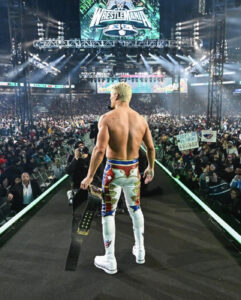
This contributes to deep storytelling because it builds a long history for this character that is seen by the audience and can be referenced at any point to highlight character or story beats. And the fact that this history occurs in real time alongside the viewer, so as we age so do the characters, only further heightens the emotional stakes of the story. Let’s use my favourite wrestling story and as an example: Cody Rhodes and his quest to “Finish The Story”.
What is “Finish The Story”?
April 4th, 2022. A suited man stands in the middle of a wrestling ring. An arena of over 10,000 chanting his name. He has bleach blonde hair and a gaudy American flag neck tattoo. His name is Cody Rhodes. Speaking into a microphone, Cody tells the audience to look at the big screen. It shows a picture from 1977 of his father, legendary wrestler “The American Dream”, Dusty Rhodes, holding the WWE Championship Title above his head in celebration.
Cody explains that despite the celebration, due to a rule technicality, his father was not officially the champion. In fact, his father would never be the WWE Champion as he left the company not long after this moment. Dusty would join the WWE’s competition and do his best to compete against them and prove to the WWE’s owner, Vince McMahon, that he should’ve trusted him to be champion. Vince never forgave Dusty for this, perhaps because Dusty was Vince’s favourite wrestler. So, when the WWE monopolised US wrestling, becoming the only game in town, Dusty was out of work. He and his young family fell on hard times so he accepted a contract to work with Vince again, despite not fully trusting his intentions. The paycheck was too hard to pass up.
Instead of using Dusty’s star power to better the show, Vince treated him as a silly sideshow, dressing him in a ridiculous polka dot outfit and putting him in sketches where he did embarrassing jobs like cleaning toilets. Dusty did it all with a smile on his face. While it wasn’t the worst thing Vince could’ve done, it wasn’t doing the star power and skill of Dusty justice and was a purely petty move that actually hurt Vince’s business. It was just a way to get back at Dusty for his perceived betrayal.
Despite never officially being champion, and despite the rivalry with Vince, Dusty always had that picture of him with the WWE Championship framed in his home. Cody explained to the audience that as a boy he grew up seeing this picture in his home, believing his father was the greatest champion in the world. Eventually, Dusty had to painfully explain to his son that he was never the champion. In that moment, a young Cody Rhodes promised himself and his father that one day he would win that championship and award it to his father. He would tell him that no one would be able to take it away from him.
Not long after this conversation took place, a new competitor to the WWE arrived and promised Dusty a more prominent, less physical, management role which Dusty accepted. With no way now to directly harm Dusty, Vince turned to Dusty’s first son, Dustin, who was a young wrestler full of potential albeit a bit bland. This is where Vince really twisted the knife into Dusty. You see, Dustin could’ve easily been a steady, consistent hand, however, Vince didn’t want that. Instead, he convinced Dustin to portray the character of Goldust.
Goldust was an androgynous porn-film adjacent wrestler who wore a long blonde wig, painted himself in gold, and wore a tight black and gold latex outfit to the ring. Playing on gay panic stereotypes and BDSM aesthetics, Goldust would touch his opponents in unconsensual sexual ways to play mind games with them and get an advantage in the ring. This was done as a way to garner boos from the crowd. Dustin, just as his father did with the polka dots, acknowledged the ridiculousness of the character he was asked to portray but took it in stride and did the best job he could. However, this was also one of the darkest times for Dustin’s personal life, having troubled relationships with his family and drugs. Portraying the Goldust character each week certainly couldn’t have helped and put a strain on Dustin’s relationship with Dusty. Clearly, the Goldust character was a way to get back at Dusty for his rejection. Saying “look what I did to your son”.
So, 10 years later, when Cody, a fresh-faced early 20s nepotism hire, joined the WWE, there were justified concerns. But Cody had something special. Many people could see it. He impressed everyone at his father’s hall of fame ceremony when, an unknown at the time, Cody delivered an emotional, rousing speech to a room full of legends with utter confidence. After this, Cody’s early WWE career was promising. He was a part of a heavily featured faction, Legacy, learning underneath main event star Randy Orton and, privately, being the driver for face of the company, John Cena.
After a few years of growing, Cody, no longer the scrawny bare-kneed kid, but a burly young man, seemed ready to break out into the main event. The crowd were behind him and his skills were there but Vince never pushed him to the top. Instead, he chose a young wrestler from the legendary Samoan wrestling dynasty, Roman Reigns. This was despite Roman’s noble babyface character being completely rejected by the audience and met with deafening boos every night.
Meanwhile, Cody fell all the way back down the card. Eventually, Vince gave him the character of Stardust. A twist on his brother’s Goldust character, minus the sexual nature. Stardust was a raving lunatic who painted a big star on his face, talked nonsense about galaxies, and lost all of his matches. The cycle had repeated once again. Vince had embarrassed Dusty for a final time.
Not long afterwards, the legendary Dusty Rhodes passed away. Cody’s world was destroyed. His north star, his hero, was gone. This wasn’t how it was supposed to go. Something had to change. So, Cody left the WWE. Three years after his departure and reinventing himself as a main eventer in other companies, Cody, along with Tony Khan, Kenny Omega, The Young Bucks, and many others, started AEW, WWE’s biggest wrestling competitor in twenty years. Cody was truly following in Dusty’s footsteps.
Finally, back in 2022, we come back to this moment with Cody in the middle of the ring showing the crowd this picture of his father. He had shockingly returned to the WWE from AEW looking like a new man. After the time away, the crowd instantly accepted Cody as their hero. No longer the nepotism hire full of potential, the young naive boy desperate to fill his father’s footsteps, but the prodigal son returning to the kingdom to fulfill the prophecy.
After years of Vince trying to force the audience to accept Roman Reigns as their hero, he finally capitulated and accepted Roman’s natural role as the biggest villain in the company. This marked another failure in a long line of candidates that Vince tried to force the audience into accepting as his next face of the company. And now, the true face was standing in the middle of the ring. And he was undeniable.
Why this is my favourite story in wrestling history
I’ll save the rest of the story for another time. I guess you might already know how it ends, but, if you don’t, I implore you to explore it for yourself and watch some Cody Rhodes matches and segments from this time period. I just wanted to use it to illustrate how unique the stories in wrestling can be. All of what I wrote actually happened. None of it was written or planned. These were all real events that happened to the real people behind the performers over 50 years and two generations.
There is no other medium where this reality can be so directly addressed and leaned into to create a fulfilling and emotional fictional narrative. It’s only fictional because, after the point where I stopped telling the story, the rest, for the most part, is written and planned out. The wrestlers and writers could then sit around and figure out how to pay off these years of real events on their fictional television show.
Cody’s goal, in-character and in real life, was to win the WWE Championship. This creates a compelling meta-narrative where the fans can follow along the story on television in the fictional world and in real life behind the scenes. Does Vince’s grudge against the Rhodes family stop him from pulling the trigger and writing Cody Rhodes to win the WWE Championship? Does Cody get seriously injured the day before a big match forcing them to choose someone else to replace him? Does a wrestler with more political power than Cody steal his spot in the championship match? What if, during Cody’s championship match, his opponent accidentally kicks him in the face too hard, concussing him for real and causing him to not kick out of the pin as planned?
All of these things could and have happened in the past. Even though wrestling is scripted, you never know what’s going to happen until the bell rings. It could all change in a second. Reality has a much more direct impact on wrestling than any other storytelling medium. This makes its stories feel real and full of heart. When I’m watching Cody Rhodes fight Roman Reigns for the WWE Championship, I need Cody to win because he really was that kid who promised to bring his dad the championship. I watched Cody as I was growing up. I saw him improve in real time, and I saw him fail too. He really was the son mourning his father’s loss. He can’t fill the giant hole that “The American Dream” Dusty Rhodes left, but he can adorn it with the one dream Dusty never accomplished.
Wrestling stories are real
When I was younger, I didn’t see much potential in Cody. He looked good, he wrestled well, and the crowd liked him. But he wasn’t the biggest guy on the roster, nor the best technical wrestler, or even the most popular. He was a steady hand. I thought “World Champion? No way”. So, 10 years later when he returned and said that everything he does down to his choice of clothing is all because he “wants to be somebody”, I see myself. And, I think everyone can see themselves in that too.
A steady hand? Sure. Good enough? Sure. Not the best, not the worst. But, someone who actually accomplishes their dreams? Someone who stops talking about doing it “one day” and actually does it? Someone who’s brave enough to become the person they’ve always wanted to be? No way. That’s too scary. It’s too hard. But, when I see how far Cody Rhodes has come, from wrestling as Stardust in front of bored, silent crowds to now getting standing ovations no matter which country he goes to. Hell, I flew across Australia in 2024 just to see him talk, not even wrestle. When I think about how impossible everyone in the world, including sometimes probably Cody, thought this future was (it’s cheesy but it’s true) I think that I can accomplish my dreams too. And that’s the beauty of wrestling. It is real. That’s what makes it so good. The real, lifelong story behind each wrestler.